
Mentally acute Mercury is responsible for two signs in classical astrology: Gemini and Virgo. Although the signs share interpretations related to information, communication, movement, and transactions, there are distinctions.
- Gemini is a Mutable Air sign; the essential urge is to learn about concepts and ideas by breaking them down into separate and opposite components. It is considered a masculine or assertive place and the daytime home of Mercury.
- Virgo is a Mutable Earth, and the essential urge is to organize and recombine concepts and ideas for a practical, material purpose. It is considered to be a feminine or receptive place where Mercury dwells at night.
The duality is established.
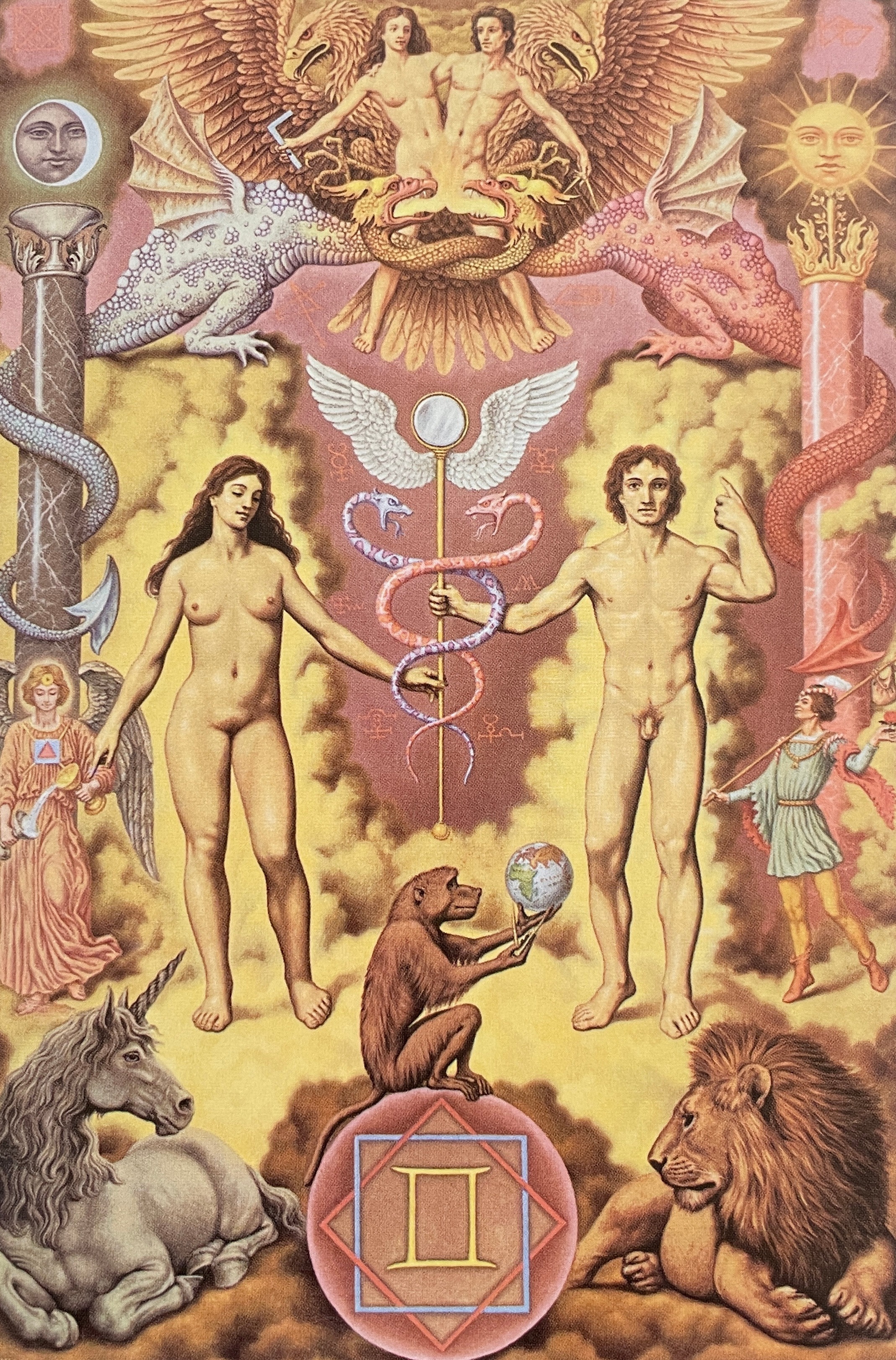
Johfra Bosschart’s illustration of Gemini is filled with dual images—from the twins at the top of the card to dueling dragons, the Moon and Sun, two pillars, two serpents, a man and a woman, etc. The singular figure near the bottom of the painting is a primate gazing upon a globe, a reference to the evolution of the human mind and our endless need to identify, categorize, and name things.
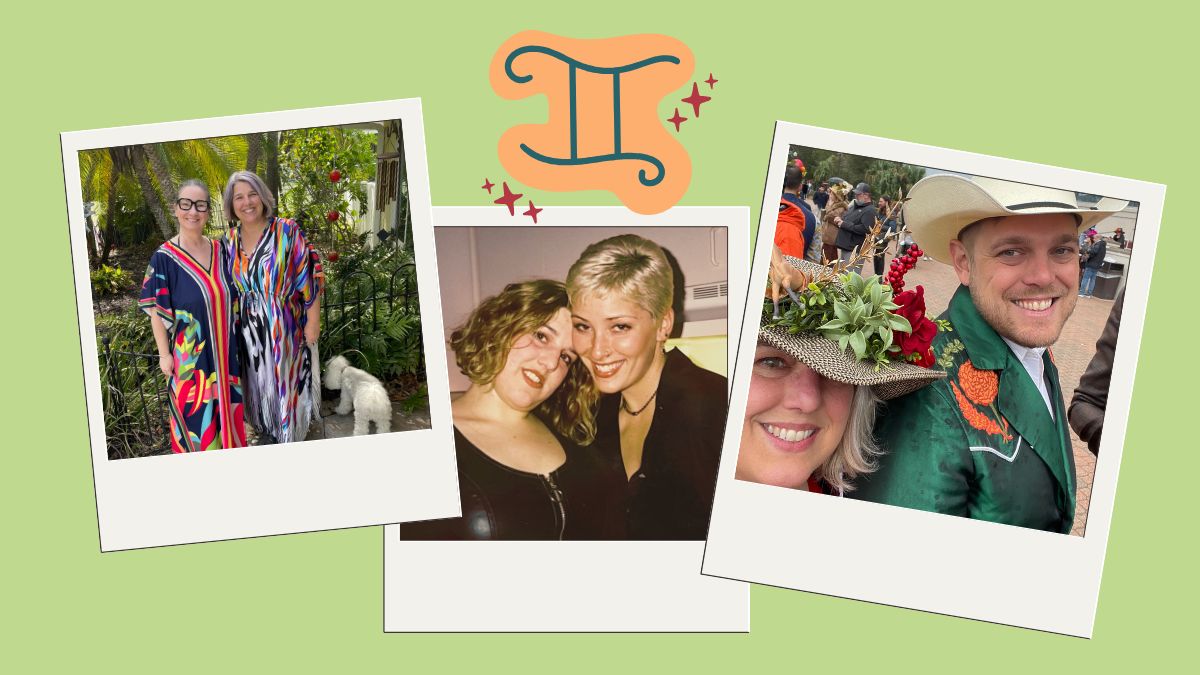
The sign of the Twins is classically associated with articulate, educated, and witty people. I collect people born during Gemini season, probably because the Sun in Gemini makes a complementary trine to my natal Sun in Libra. Our conversations are always lively and roam freely from topic to topic. No matter how much time has passed since we talked, we can pick right up again.
Gemini is associated with professions like poets, musicians, interpreters, business people and merchants, critics, scientists, and occult practitioners. My best friend, born at the end of May, is a hairstylist who uses her arms, hands, and voice (all body parts associated with Gemini). Sometimes, Gemini appears in trickster and shapeshifter archetypes, like liars, thieves, and con artists - people who use words and ideas to sell.
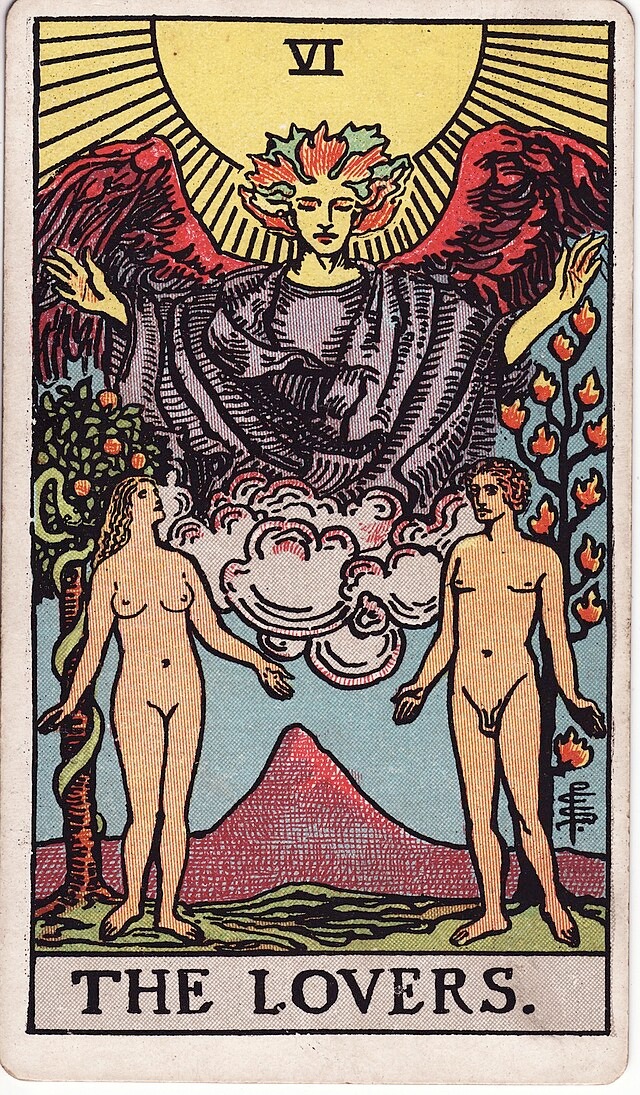
The Lovers (card 6) is associated with Gemini in tarot decks. In the Rider-Waite deck, the central image is an angel watching over a nude couple, evoking the biblical Adam and Eve. The woman stands near the Tree of Knowledge, and the man at the Tree of Life. The Garden of Eden story I learned in childhood sets a foundation for humanity’s separation from God and is a root for patriarchy and gender conflict. In the tale, the woman is described as a sinful temptress, luring a man to eat a forbidden apple. Their actions result in exile from paradise and Earthly pain and suffering.
These days, the story and imagery turn my stomach, yet I think it’s important to acknowledge as a fundamental teaching of Christian nationalists.
“Every explicit duality is an implicit unity.” - Alan Watts
It’s hard to contemplate duality without thinking about non-duality.
Spiritual leaders from the Buddhist tradition write and teach about transcending dualistic or bi-polar thinking. As I understand it, non-duality is an awakening or awareness that separation is an illusion of the human mind, while ‘reality’ is that all things are intrinsically connected with one Source.
“All existence involves contrasting pairs. When one is present, both are present. When one is absent, both are absent.” - Wu Cheng (1249-133 CE)
Duality separates and creates conflict between opposing ideas. For example, there is no wealth without poverty. No good without evil. No us without them. No illegal without legal. No righteousness without sin. There are no losers without winners.
“There is a strange duality in the human which makes for an ethical paradox. We have definitions of good qualities and of bad; not changing things, but generally considered good and bad throughout the ages and throughout the species. Of the good, we think always of wisdom, tolerance, kindliness, generosity, humility; and the qualities of cruelty, greed, self-interest, graspingness, and rapacity are universally considered undesirable. And yet in our structure of society, the so-called and considered good qualities are invariable concomitants of failure, while the bad ones are the cornerstones of success…Perhaps no other animal is so torn between alternatives. Man might be described fairly adequately, if simply, as a two-legged paradox.”
— John Steinbeck
It’s worth contemplating who decides which category is good and which is bad and how that categorization serves them. Many of the labels and characterizations are designed to protect the ego or justify desires.
The Lovers in the Thoth deck also features a couple in union instead of division. Opposites merge into one as The Hermit marries a fully clothed King and Queen. Several parallel figures on the card repeat the themes.
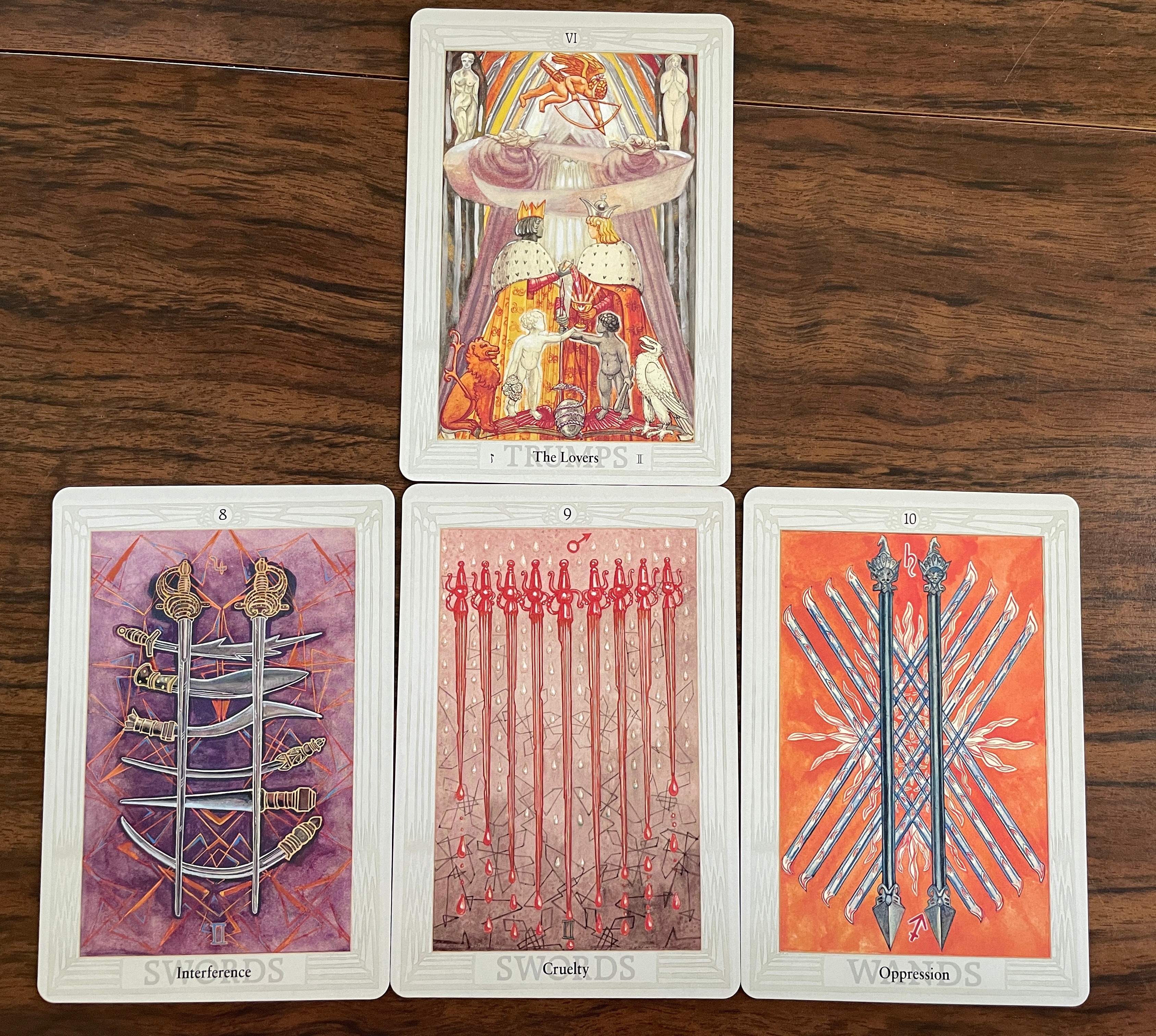
The minor arcana cards depicting the three decans of Gemini are the 8, 9, and 10 of Swords. These cards return the focus to mental activity in the air sign.
The 8 of Swords, associated with Decan 1, is ruled by Jupiter, the greater benefic. Jupiter is out of place in Gemini and prone to excess. It can bring too many ideas, too many opportunities, or too much conflict. The 8 of Swords describes Interference, a mental paralysis where you feel bound by words and concepts. If you’ve ever found yourself unable to choose between 35 brands of deodorant at the supermarket, that is the 8 of Swords vibe.
The 9 of Swords shows up in my daily tarot pulls far too often, but I’m a person who works in words and ideas. Mars rules Decan II of Gemini, which corresponds with this card. Mars heats and speeds thoughts, urging offensive and defensive action. Labeled Cruelty, this card can signify excessive mental activity that leads to anxiety, stress, nightmares, or harsh words. It reminds me of something Carrie Fischer wrote; I think it was in Surrender the Pink, but I’m paraphrasing it because I can’t locate the book. “People tell me that things are all in my head. Isn’t that the worst place for it to be?" Can’t we get it out?”
Decan III is associated with the Saturn-ruled 10 of Swords, Oppression. My nickname for this card is Overkill. I usually draw it at the final stages of evaluating student papers, editing articles, or draining mental exercise, and I’m emotionally finished but still have to show up and think. Chang and Meleen refer to “inevitable consequences.” It is the completion of a series, representing endings/beginnings in words, ideas, and conflicts.
Thanks for reading. Tomorrow, I’ll move on to Cancer. We are halfway through the 12 Holy Nights and 12 zodiac signs.
XOXO,
Denise